Wednesday, 28 November 2012

The Balance part III (conclusion)


I think what I was trying to get at the other day is that people seem to need a way of feeling in balance; at home, in a profound sense. They want to feel linked to the rest of the world about them, and not just to human society; they want to feel a sense of unity with The Way Things Are.  

Aspects of physical and biological science can help us do that via reason. For example, the characteristics we share with other living creatures, the way the seasons work on us, or the wonders and mysteries revealed by astronomy. Such insights can lead to a fuller identification with the rest of the universe - e.g. some of the things Einstein wrote in later life. Sometimes such insights are labelled "spiritual," a complex and conflicted term these days perhaps.

Before scientific methodology and rational analysis, people found this harmony in ways that might not stack up rationally, but I think they can still have a symbolic beauty for us, and even, for some of us, a functional utility.

Astrology is, I think, not rationally supportable (which is a polite way of saying that at the literal level, I don't believe a word of it!)  However, sensible, bright people follow it, including a lovely colleague of mine. It's unwise to think that people who believe irrational things are foolish; patently not so. 

We should look at the purpose, function and symbolic eloquence of such systems as astrology, even if we don't accept them ourselves. I believe they help some people who are looking for a sense of balance and belonging, unity with the universe.  Edmund, the wicked bastard in "King Lear," says in effect "It's nonsense. I'd be lecherous and uncouth whatever stars reigned over my conception and nativity." He was a modern man in his day.  

I don't know enough about other cultures to generalise, but there is one well-known symbol of balance, the ancient Chinese Yin-Yang. Like many profound things, it is beautifully simple.


Thus saieth Wikipedia, helpfully I think:

In Chinese philosophy, the concept of Yin-Yang, which is often referred to in the West as "yin and yang," literally meaning "shadow and light," is used to describe how polar opposites or seemingly contrary forces are interconnected and interdependent in the natural world, and how they give rise to each other in turn in relation to each other.

Everything has yin and yang aspects, opposite dualities that are ultimately interdependent, different ways of seeing and understanding an inexpressible unity. The symbol may have become a cliché, but the mode of thought is fascinating, and I think productive. To risk stating the bleedin' obvious, you can't have light without dark, music without silence - life without death. These dualities are not opposed, they make up the one, even if we see first yin and then yang.

The Balance. Ever changing within us and without us. If you veer away from death, deny it in your life, you drain your life of meaning and intensity. If you are incapacitated by your (natural) fear of death, you darken your life.

The Balance is there all the time, you can't will it within yourself. You can't say "I will be mindful today," or "I will stop worrying about the end of my life." 

Meditation is one way to let The Balance emerge. But enough from me, on the way. You know what's coming next:

"The Way that can be named is not the perfect Way."

Sunday, 25 November 2012

The Balance - part II


We depend on internal balances in our bodies to keep us alive, and some or many illnesses come from that balance slipping. What about balance in the universe around us?

The wider universe, astronomers physicists etc tell us, is a place of unimaginable power, randomness and (according to Hubble) beauty. Exploding supernovae, colliding planetary bodies and collapsing neutron stars, let alone black holes, are not places of balance - though just maybe there is a larger, all-encompassing balance in it all, I don't know enough physics to take that further; some would call such a balance God.


In our own planet, balance sustains us here too. Air pressures, water temperatures, ocean currents all move together, and when they are out of the usual balances, you get - hurricane Sandy etc. When the tectonic plates are not evenly balanced, you get movements to put them back in balance and - people suffer earthquakes.

A holistic view of medicine is almost a commonplace now - looking at the whole person to see where in her systems something is out of balance, rather than finding a magic bullet drug to deal with the symptoms of one problem. (Mind you, magic bullets are very useful sometimes!) The quest is to get the person back in balance, as far as possible.

In medieval and Renaissance times, it was taken as a commonplace that we are composed of four humours (black bile, yellow bile, phlegm, and blood.) OK, it's quaint - remember, they hadn't yet found out that blood circulates round the body, and they had little idea of what the brain did. They believed that if the four humours weren't in balance, you fell ill, or at best behaved oddly. Too much blood made you choleric, i.e. bad tempered. Too much black bile made you depressed. The work of Shakespeare and his pals is full of it - one of Ben Jonson's plays is called "Every Man Out Of His Humour." These people were not stupid primitives. They simply made wonderful work out of prevailing beliefs, which is all you can ask of any artist at any time, surely.

The four humours corresponded to the four elements of earth, air, fire and water, and again, these elements were made to stand in for personality types, or even types of creature: Ariel, in "The Tempest," is all air. Caliban is all earth.

Furthermore (hang in there please, there is a point to all this) the elements and the humours were influenced by the motion of the stars and planets. Human affairs were thus affected by heavenly bodies. "When beggars die, there are no comets seen. The heavens themselves blaze forth the death of princes." (Cue convenient comet...) And vice versa.

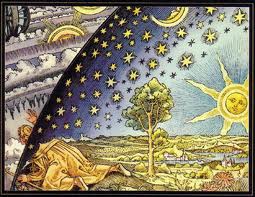
Before the great 17th and 17th century astronomers - Coppernickers, Galileo, Kepler and all - everyone thought the sun and the planets and the stars revolved around the earth. They were fixed on crystal spheres, which made impossibly beautiful music, if you were spiritually advanced i.e. holy enough to hear it - the music of the spheres. Outside the stars and planets was - God in heaven. The stars etc, and of course heaven, are unchangeable. Below the moon (i.e. on earth) all is change, all is mortal. On earth was mankind, higher than the animals but "a little lower than the angels." At the centre of the earth was hell, and at the centre of hell was - Satan himself. God-angels-mankind-animals-devils-Satan.


(This is all too neat, there were lots of variations...but for now...)


So what is sometimes called the Great Chain of Being linked God in heaven through the stars and down to mankind on earth, trying to be good so as to ascend to heaven. Stars etc affect our moods, our health, the events in our lives. It's all linked. The virtuous, healthy person keeps it all in balance; the sinful or just plain ill person has lost their balance. Huge injustices on earth will be mirrored in the skies, as happens when Julius Caesar is murdered, Macbeth kills Duncan.

OK, the universe, we learn from science, isn't like that. (Put God where you like, He's not the issue here.) Our bodies don't work like that. When awful things happen on earth, the stars couldn't give a damn - they are too busy being convulsed in beautiful and terrifyingly vast explosions.

But hang on - out of all this, lets pull The Balance. Because we are not just machines to be oiled by medicines. Emotions affect physical well-being affects emotions. The passage of the seasons affects us, via amounts of sunlight falling on us. Our brains are continually modified by how we use them, i.e. by the impact of The World on them - printed book, or X-Box? Both will influence the structural working of your brain. The world moves through us as we move through the world. 

The beautiful intimacy of the old Chain of Being myths no longer convince. 

But we generate and expend energy every day seeking The Balance, at which we will function best - healthiest, happiest. Millions of people go walking, listen to music, meditate, in order to feel balanced. When we run out of energy, our bodies give way, and we die. We have had to give up the balance through which we live.

The pre-Copernican universe, the view of our bodily workings pre-modern medical science, these myths were just rather lovely ways of trying to comprehend order and balance in the universe. We know enough now to maintain essential balances, which is just as well, because order and balance isn't inherent in the workings of the universe, in any physical sense. We know enough to hold the balance, but all too often we don't seem to be able to bring the knowledge to bear.

This isn't my clearest ever post, but there is something here I don't want to lose sight of.

Monday, 19 November 2012

The Balance:depression and meditation


Our bodies need to be in balance for life to continue. Apparently our endocrine systems (glands, mate, and not just the two you are probably most interested in) work continuously to sustain the balance of our systems. When the balance slips, we get ill. White blood cells/red blood cells. Sugar/insulin. Etc. 

One crucial balance is between movement and stasis, energy and tranquillity. It seems that when people suffer from depression, the sort that is induced by stress and exhaustion, this is what happens: the limbic system in the brain that controls our moods, is unbalanced because it is overloaded. We are trying too hard, we want to please, to get things done, to validate ourselves. Bang. It's too much. The fuse blows. The mood sinks down and down.

Seretonin, the hormone that is important in connecting up the tiny neurotransmitters in our brains, can't do its job properly. Slump. Tears about nothing in particular, exhaustion, and at its worst, Sylvia Plath's "Bell Jar." You can't connect to a world deprived of meaning, you can only see it through the glass. You are disconnected, and isolated. 

To use a modern term, depression really, really sucks. And it is widespread; it seems endemic in our culture. It is a real fully-grown illness, not just a bad mood; if you are suffering from depressive illness and a well-meaning friend tries to tell you get a grip, it'll pass, pull yourself together, try and muster the energy to tell him thanks, but just piss off. It's like telling someone with with a broken leg  to get a grip and hurry up.

(Any neuroscientists/doctors reading this can stop sniggering please and go and read something else; I'm doing my best...besides, my real point isn't hormones, it's balance.)

People who suffer from depressive illness, argues - no, demonstrates - Dr Tim Cantopher in his outstanding book "Depressive Illness: the curse of the strong" - may feel they are weak, they have failed. Not so. It is their generous strength, their sensitivity, their outpouringness, the high standards they relentlessly apply to themselves, that got them depressed.

One thing such people do is worry like mad about upcoming things, and worry like mad that they haven't done something as well as they should have done. Dammit, that's just exhausting, isn't it?

What mindfulness meditation can help you do is to live in the present. Doesn't stop you planning and achieving, doesn't stop you doing things well. In fact it will help you do so by keeping you in balance, saving your energies, preventing it happening again. It will lessen your worries, ease your anxieties, find The Balance. You'll still be sensitive, hard-working, generous, but in balance more of the time.

This isn't snake oil, I know it works. You may need anti-depressant medicines, but the meditation will come in longer term and stave off your system's tendency to get out of balance by doing too much.

More about The Balance next time - yes, watch out, I feel a miniseries coming on...


Friday, 16 November 2012

Mindfulness and "ordinary" life

Meditating every day for a certain length of time can be difficult if your regular routine is disrupted, for good or less good reasons. Recently I left Mundi Mansions with the Long-Suffering One for a short break, which we filled with lots of visiting. "Hold everything for 45 minutes please whilst I meditate" is still possible, I guess, but not an appealing offer.

So I thought I'd use the holiday time to work on the border between structured meditation and "ordinary" life. (Ain't no such thing - perhaps "usual life" would be better.)


Throughout the Isles of Britain people are exclaiming delightedly about the autumn colours this year, and the length of time it is all lingering. So an autumn stroll was obviously a prime time to let go, look at these leaves here and now, and simply be, in silence except for shuffling feet. Even for three minutes, it felt good. And even I can shut up for three minutes without anyone starting the search for a pulse.


The almost flat, grey, empty North Seascape was also ideal. An early morning stroll whilst the LSO got ready for the day was a good opportunity to take five just watching the horizon. I think the knack of it is not to contemplate the beauty, but just to be in it, and do the usual focusing on the breath, feeling the ground against the feet, moving the thoughts to any sounds as they occur, returning the attention to the present - all as usual, but a different here and now, especially a beautiful one, seems to help. And it was followed by a particularly good breakfast.


Who likes slow traffic, who likes driving long distances on our motorways? I found just a minute or two on a motorway services bridge surprisingly useful for a short burst of the old here and nowness. And it was surprisingly beautiful, too. The knack seemed to be - to let it be itself, and to let me be a part of it. Not a generic scene "typical M6, busy evening" but this in front of me, now. Of course, watching steady traffic is hypnotic; that sort of hypnotic (I don't mean Arkayeff's hypnotic!) can work against being in the present, but for a couple of minutes, it was fine. A different sort of refreshment from the thing I'd just about managed to eat at the other end of the bridge...

These short moments, these pauses and stillnesses, don't work for me in the same way or at the same depth as a lengthy, structured meditation does, but they are invaluable. 

"What time does the meditation class begin?"
"It's always happening."

Now that's a state of being,  worth not striving for but simply becoming. One day. Even on the M6.

Friday, 26 October 2012

An architect of troubled sleep?


In his excellent, humane and practical book "Depressive Illness: the curse of the strong," Dr Tim Cantopher warns sufferers (or any of us) about the various ways we can make it difficult for ourselves to get to sleep at night, and how to get round those sleep preventers.

My current sleep preventer is an old friend who has turned against me, and specialises in spiteful and abusive rhetoric. So of course I spend far too long running scripts, working out justifications and defences, and generally bothering myself up. Needless to say, all this hurt comes welling up at bedtime. I can't get to sleep.

You can't will yourself to go to sleep, can you? Worrying about not sleeping guarantees you won't sleep. So - what can mindfulness offer, how can being in the present moment help?

Firstly, the simple insight that what is troubling me at bedtime are thoughts - my thoughts, and nothing else. My ex-friend is not attacking me at that moment; the assault comes from the thoughts her actions have generated. There are no other events or phenomena at the time I cannot sleep - it's just thoughts.

Secondly, before I go to bed, a simple fifteen-minute meditation in front of an open fire or a candle (seems to help - beauty, reflections on changing states, awareness of transience, but mostly beauty.) Sit solidly, upright. Let the mind settle on the breathing. 

Bring the mind back to the breath, gently but firmly, when it starts running scripts. 

"And another thing - she said that I..." 

"Woa. Of course you feel these things, no blame, just get back to the breath.." 

It's the bringing back of the mind to the breath in the body that helps to create presentmomentness, so no self-criticism if thoughts wander, just return them. Meditation is a process, not a work of art.

Extend awareness to the whole body, sitting here, now, in front of this fire...and so on. (All a bit bald in text, but there are good CDs available to guide us in such meditations.)

Ten or fifteen minutes of this, and then slowly, deliberately and calmly to bed. Really works. She is no longer an architect of troubled sleep, and nor are my thoughts.

The other thing that works is at a common-sense level. Saying to myself three times each morning "she has behaved like a lying cruel cold-hearted piece of shit...."

Er - and then remembering that she's probably not in a happy state of being herself, or she wouldn't need to be so abusive. So - compassion, Gloria, compassion....grievances are an enemy of presentmomentness, stay in the now. Move on. She's an ex-friend, that's sad, too bad, you did what you could and it didn't work. So it goes. Acceptance.

Yup. That's better. 

But she's still behaved like a lying cold-hearted piece of shit.... 

Oh dear. It seems there are limits to mindful compassion; ex-friend may well have reached them. Final step - distance, calm, quiet. Let it all rest in the past. 

Goodbye, ex-friend. Go well. Without me.


Monday, 22 October 2012

A Good Song for a Funeral?


Is this a good funeral song? The title works, but like many songs that get used for funerals, it seems in fact to be about a love relationship; it abruptly works into context towards the end.

It's Bob Dylan's song, couldn't find the original, so thought Ms Peyroux's versions pretty cool, and it's easy to hear the words. Nevertheless, here they are:


I’ve seen love go by my door
It’s never been this close before
Never been so easy or so slow
Been shooting in the dark too long
When somethin’s not right it’s wrong
Yer gonna make me lonesome when you go
Dragon clouds so high above
I’ve only known careless love
It’s always hit me from below
This time around it’s more correct
Right on target, so direct
Yer gonna make me lonesome when you go
Purple clover, Queen Anne’s Lace
Crimson hair across your face
You could make me cry if you don’t know
Can’t remember what I was thinkin’ of
You might be spoilin’ me too much, love
Yer gonna make me lonesome when you go
Flowers on the hillside, bloomin’ crazy
Crickets talkin’ back and forth in rhyme
Blue river runnin’ slow and lazy
I could stay with you forever and never realize the time
Situations have ended sad
Relationships have all been bad
Mine’ve been like Verlaine’s and Rimbaud
But there’s no way I can compare
All those scenes to this affair
Yer gonna make me lonesome when you go
Yer gonna make me wonder what I’m doin’
Stayin’ far behind without you
Yer gonna make me wonder what I’m sayin’
Yer gonna make me give myself a good talkin’ to
I’ll look for you in old Honolulu
San Francisco, Ashtabula
Yer gonna have to leave me now, I know
But I’ll see you in the sky above
In the tall grass, in the ones I love
Yer gonna make me lonesome when you go

Wednesday, 17 October 2012

mindfulness for schoolchildren


I think this is very interesting. It's a programme for schoolchildren, offered, at a price, by the Hawn Foundation. There are some cross, and some not very rational, comments from teachers in the USA about this programme, on YouTube. And in fact the comments, too, are interesting. 

All respect to the point about the money the programme costs compared with the fact that one reason why a of lot children can't concentrate is down to material factors (e.g. no real breakfast...) But mindfulness meditation is a material factor, in that it can change children's behaviour, calm them down, help them concentrate, help them - if they need it - to feel better about themselves. It develops the way the brain works; so does a good breakfast. 

Changing a young brain's characteristic patterns can be done in many ways - playing violent video games, for example - or doing a little meditation to help them in their school work. But it's all material - electric currents and hook-ups, chemical changes.

For some people, we need to keep saying: it's not a religion, it's not based upon religious faith.  The changes in people's patterns of thought when they meditate are observable via the usual electronic kit they stick on your head to measure brain waves, or in more detail via MRI scans. It's not a matter of faith. (Though naturally, if you believe it is helping you, it's more likely to do so.)

You might have your own views on how much it helps to have Goldie Hawn's name behind this programme. You may extend little sympathy in her direction because she was one of those who helped to develop the "dumb blonde" stereotype beloved of sexist comedians and saloon-bar wits; but those were her acting jobs. She's certainly trying to do something here that seems to me very worthwhile.

I always like the criticism "it's all touchy-feely." a) it isn't. b) would it be better if it was all done in a macho sort of way, more football coach than meditation teacher?

Children who are more proficient at being in the present, at being mindful, may perhaps grow up more able to accept their own mortality, be less death-haunted and more death-accepting, better able to accept that life is risky, impermanent, and precious because it ends. I would have thought, in a culture where many are obsessed with death-fantasy, with the idea that you can kill all the bad guys one day, with the idea that God is on our side - that a mindful child is a precious asset.