Showing posts with label secular funerals. Show all posts

Friday, 24 August 2012

Funeral celebrancy - a paradoxical status


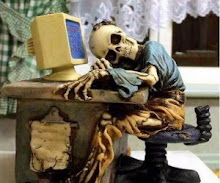
I sometimes feel a bit like the little chap in the picture, making something (a ceremony) in which my role looks simple in plan, but turns out to be full of paradox, ultimately impossible. 

Any celebrants out there dis/agree with any of this? Do chip in:

1. I didn't know the person who's died, but I have (usually) to present a picture of her - life story plus essential characteristics, looking for the spark of recognition in the upturned faces. If I overdo it, people will feel I am being presumptuous. If I undercook it, the congregation will find it harder to feel the connection. A catalogue of jobs, hobbies and retirement activities, and health problems doesn't do. We need to feel the uniqueness of the person, but the only possible view, for me to use, is the one from one or two people in the family. It's my empathy, imagination, background knowledge I shall have to draw on. Mustn't over do it....

2. I want to give the event some ritualistic power, some ceremonial effect, but the common threads for assembling such a thing are few and faded. Ritual and ceremony evolve over time, but we're trying to invent them. It kind of works, sometimes. 

3. I need to stay in control of the ceremony, however distressing the circumstances. But celebrants who can't bring love and compassion to the people they are working for should perhaps be doing something else. Those qualities cannot be faked as part of a professional performance, but my part of the proceedings needs to be calm and ordered. I need to be moved, I won't help anyone if I lose it.

4. I draw on my own emotions, my own thoughts about mortality and loss, but if I draw too deeply I run the risk of exhausting and depressing myself. If I don't draw upon anything of mine, the ceremony may lack my own personal commitment, therefore it will lack authenticity. If I drain myself over a few weeks, I'll be less able to energise the next funeral.

5. I don't want to take on too many funerals (see above) but if I turn down a request, I worry that a suitable alternative may not be available. (That's not, I hope, vanity, merely availability of celebrants who are at least as good (or bad) as me.)

6. I'm not in it for the money, but I find it difficult sometimes not to feel cross about the attitudes towards celebrancy fees from the rest of the funeral so-called profession.

7. Who am I to talk about the meaning of a life I never knew, and draw from it something for the people to carry away with them? Yet I know how hard it is for family members to make that sort of synthesis - much as I want to see them do as much of the funeral for themselves as they can. It's probably only people with considerable cultural resources, time, maybe money, who can do that for those close to them.

8. Celebrants often feel they need to present an honest picture of the person, but they don't want to hurt feelings, they want to help people along with their grieving. It's not a forensic activity; yet no-one respects a whitewash.

9. Celebrants often want to transform the way our culture "does" end-of-life matters in general and funerals in particular. But here and now, most people want something fairly or very conventional.

10. There is no such thing as a secular funeral that is ideally suited to purpose, occasion and dead person. It's an impossible job. 

It's the best job I've ever had.


Monday, 31 May 2010

Fruitless arguments about secular celebrants vs priests

There's been a good discussion, thanks to the indispensible GFG blog, around the relative virtues and powers of "secular" celebrants (those who help with a non-religious funeral) and vicars/ministers/priests. It's interesting enough, and helpful, to kick around, but it seems to me yet another of the ultimately futile binary oppositions that seem to bedevil public discourse. Charles (GFG) makes the point that there's good 'uns and bad 'uns in both camps. He extols the power of a good old church funeral - rightly in my opinion, but that's not much use to a non-believer! I'm going to weigh in with a few (or even grossly over-) simplifications.


1. Funerals aren't artefacts for our aesthetic assessement and judgement. We may, as celebrants and undertakers, have the experience to make very well-informed judgements, and consider what a funeral "should" be. These insights may help us to guide families, and valuable changes to funeral practice may originate in such guidance, as well as in the views of the more creative, thoughtful, resourceful and strong-minded of bereaved familied we encounter.


2. Funerals are for the bereaved and the person who has died. Do what they want as well as you can, and if they want the standard so-called "traditional"secular job, get on with it and do it well. If they want a priest, they should have one, if they don't, fine, and don't fudge it. I've met priests who have turned down funerals because they were asked not to mention God, ditto secular celebrants who guide a family back to a priest if the family is unable to let go of God and an afterlife. I also know of priests in retirement who will turn in what they call a non-religious ceremony on request. Hope they don't have too much trouble at the pearly gates, encouraging atheism like that.... Of course, the discussion is often more complex (eg differing family views) than that. And I find it unattractive, the way some of us BHA celebrants sneer at "mix and match" secular celebrants who will allow a hymn or a reading from the Bible. Don't do such ceremonies if you don't want to, but I'm afraid the real reason for sneering is that we are worried about competition, fame and fortune for the "brand."

It's the family, stupid. The rest of it is irrelevant. However much you do or don't get paid, if you're not in it to serve people in front of you on the day, rather than the cause and the cash, then bugger off out of it, whether you are priestly, secular or somewhere in the middle.


3. Funerals shouldn't be a vehicle for you to spread The Word. Any Word. Many are the stories of priests who distress the bereaved at a funeral by banging on about going to church, "didn't see enough of him, hope to see more of the rest of you," etc. Conversly, the BHA is keen on the way funerals spread the word, serve a movement. This may be for the best of motives, but I relate that to the "mix and match" criticism. We don't help with funerals in order to increase our "market share" (shudder) of funerals we can help with. The proportion of secular funerals to people who declare via census and occasional opinion poll that they have no religion, assessed as the number of deaths nationally that might be expected to result in a secular funeral, might arguably suggest that there is still a job to do to inform people about their options - but that's about secular funerals as a whole, not neccessarily BHA or Secular Celbrants or any other "brand" (more shudders.)

Here's the paradox: if you are an atheist, then the form of words used by religious people shouldn't trouble you - they don't, in one sense, mean anything to you! I wonder how many atheist celebrants are happy to sing Christmas carols once a year, but get very sweaty at the request for one hymn at the end of a funeral, "because he always loved it, although he didn't believe it?" Seems to me the only sensible argument about "mix and match" is that it is confusing. You wouldn't expect a Hindu priest to start reading from the Koran.

I really can't see we're going to provide better funerals by quarreling over faith/not faith. I don't like fudges, and I would guide a family back to a priest if they wanted prayers and so on. That's not the result of a metaphysical allergy, it's about what I can do without feeling phoney, inauthentic etc, and the gathering would soon sense it if I was. It would begin to sound like someone else's job. Funerals need to be powerful and effective ceremonies - rituals, if possible - and they need to be detatched from the business of a movement, spreading or defending the word, of God or of Lucretius and David Hume. (Enbodying the words of God or Lucretius in the ceremony is, of course, not the same as being a missionary for either of 'em.)

OK, that's all rather opinionated, but I worry that in our culture we sometimes do two mutually opposed and wasteful things: we over-sophisticate simple enough issues, and yet at the same time we bang away at binary oppositions that needn't exist, certainly needn't dominate discussion and practice. And looking at the best things I've encountered on the internet, happily they often don't, so maybe I'm just toning up for the next time I encounter a self-serving celebrant, be s/he priest or atheist! Maybe it's just my aversion to zealotry in these matters.