Showing posts with label beliefs. Show all posts
Sunday, 17 August 2014
Belief as agency rather than absolute - do you believe in reincarnation? + Tiffany Aching.
We'll get to Tiffany Aching in a minute.
I reckon anyone making use of the insights and practices of Buddhism has, sooner or later, to decide what they think about reincarnation.
I don't "believe" in it, by which I mean that I think it is so unlikely that it is not a useful or helpful concept for me to live with - though it may well work well for others.
I am treating reincarnation as a belief, an "either/or" sort of concept, or at best, a "may be/probably not" framework. Either you do or you don't believe in it.But belief doesn't have to be an absolute; it can be an agency you use to do something important for yourself.
I was in conversation recently with a very special and longstanding friend of mine. He has a medical (i.e. a scientific, rational) background alongside an open and enquiring mind. I think he is one of the wisest people I know - which statement would make him snort, I am sure.
He told me that a long time ago he realised he was blaming his parents for everything that he felt was wrong with himself and his early life.
As you do, or as many of us do from time to time.
So he took up a working belief in reincarnation. The work involved was thinking himself through to a different sense of self; if he was a soul (spirit, whatever) born into his current body and his current life, then neither he nor his parents had any control over who and where he was as a child.
For about ten years he used a belief in reincarnation to work through his resentments and deal with his blaming. When he had done so, he found the belief simply fading away. It had been an agency which, consciously and deliberately or not, he had used to heal himself.
Until I guess he reached a more existential position in which, as Tiffany Aching might say: "This I choose to do. This I accept responsibility for."
Labels:
beliefs,
Pratchett,
reincarnation
Tuesday, 11 March 2014
Letter from China: "spiritual?"
I've often skirmished with this word "spiritual;" it gets used easily and frequently. I was told, in another working life, that someone I worked with was "a spiritual man." (I thought he was devious and unreliable, just like most of us.) Bookshop shelves are sometimes labelled "mind, body, spirit." Which means you'll get astrology books next to bibles next to Dawkins. Anyway:-
There's a huge Tibetan Buddhist temple in Beijing called Yonghegong. It's full of people doing this stuff:
which under Chairman Mao would have got them locked up or worse. (It's also full of tourists like me, c.f. St Paul's in London.) It's great to see them doing what they want. I guess it's a spiritual observance, or is it simply a religious act, which may or may not have a deeper, "spiritual" significance?
Maybe it's an example of "this is what we do around here," by which I mean religion as a cultural habit, something that feels right and homely, not usefully to be seen as a matter of belief distinctions, more as a matter of something that works for a particular group of people.
Maybe the observances at the Temple are symbolic, by which I mean the people may not believe there is a non-material being, a BuddhaGod or spirit, to whom they pray; perhaps they are simply expressing their wonder and admiration at what the historical Buddha did for them.
After all, Buddhist thinkers in the Chan/Zen tradition will tell you that Buddhism is not a religion; it has no God, in the Judeo/Christian mould. So maybe these people at the Lama Temple are not worshipping, in any way comparable with Christian worship.
Or maybe they are worshipping, in the hope that a nonmaterial entity, a god, a spirit, will interecede for them and make things better.
I mean, presumably they don't think he's actually going to eat this stuff, do they? The monks take it away when it gets rotten, surely...
All very colourful, fascinating and puzzling.
But one answer to my questions might simply be that the people with the incense sticks, and the monks, are engaged in practices which have a spiritual significance for them.
It seems to me that we use "spiritual" (in contexts where we do not relate the term to a god, a non-material power) to mean an experience that seems much more significant than our usual states of mind; something that creates in us deep meanings, connections and perceptions beyond those that we are used to.
I am certain that such experiences happen to atheists, in-betweens, and followers of a religion. I am certain that we need such experiences, and the vehicle we ride on to get there matters much less than experiencing the destination itself.
We tend to over-value belief as a definer of spiritual practices. Does it matter what someone believes, as long as what they do provides a spiritual experience for them? And provided it doesn't hurt others.
There's a huge Tibetan Buddhist temple in Beijing called Yonghegong. It's full of people doing this stuff:
which under Chairman Mao would have got them locked up or worse. (It's also full of tourists like me, c.f. St Paul's in London.) It's great to see them doing what they want. I guess it's a spiritual observance, or is it simply a religious act, which may or may not have a deeper, "spiritual" significance?
Maybe it's an example of "this is what we do around here," by which I mean religion as a cultural habit, something that feels right and homely, not usefully to be seen as a matter of belief distinctions, more as a matter of something that works for a particular group of people.
Maybe the observances at the Temple are symbolic, by which I mean the people may not believe there is a non-material being, a BuddhaGod or spirit, to whom they pray; perhaps they are simply expressing their wonder and admiration at what the historical Buddha did for them.
After all, Buddhist thinkers in the Chan/Zen tradition will tell you that Buddhism is not a religion; it has no God, in the Judeo/Christian mould. So maybe these people at the Lama Temple are not worshipping, in any way comparable with Christian worship.
Or maybe they are worshipping, in the hope that a nonmaterial entity, a god, a spirit, will interecede for them and make things better.
I mean, presumably they don't think he's actually going to eat this stuff, do they? The monks take it away when it gets rotten, surely...
All very colourful, fascinating and puzzling.
But one answer to my questions might simply be that the people with the incense sticks, and the monks, are engaged in practices which have a spiritual significance for them.
It seems to me that we use "spiritual" (in contexts where we do not relate the term to a god, a non-material power) to mean an experience that seems much more significant than our usual states of mind; something that creates in us deep meanings, connections and perceptions beyond those that we are used to.
I am certain that such experiences happen to atheists, in-betweens, and followers of a religion. I am certain that we need such experiences, and the vehicle we ride on to get there matters much less than experiencing the destination itself.
We tend to over-value belief as a definer of spiritual practices. Does it matter what someone believes, as long as what they do provides a spiritual experience for them? And provided it doesn't hurt others.
Sunday, 29 December 2013
Belief validating itself
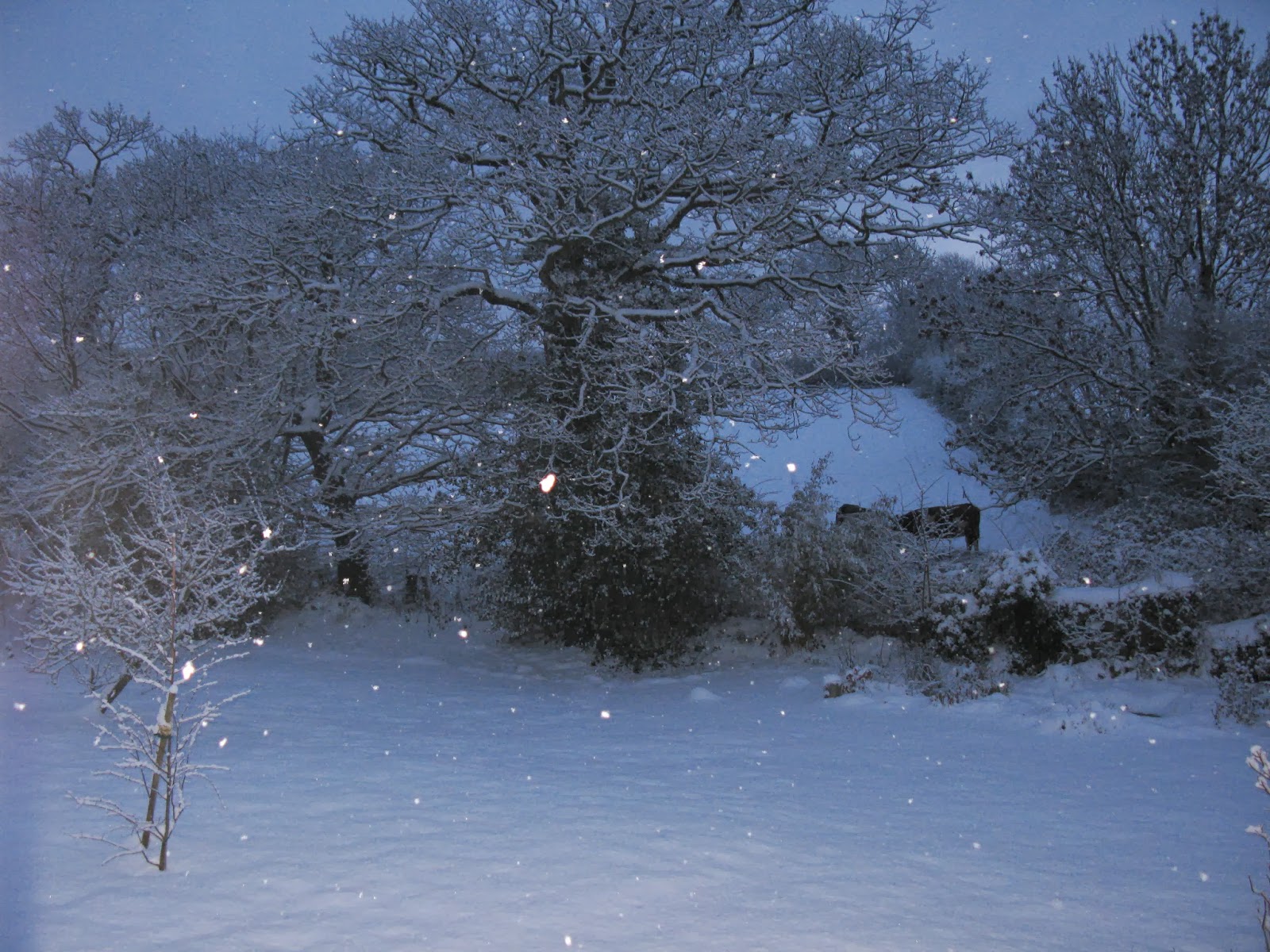
First off, things have been a bit busy at Mundi Mansions, for delightful reasons (visiting family) so it is not for Scroogist reasons that I've not offered Christmas greetings to my multitude of readers. Here's a seasonal picture of part of the rolling Mundi acres, not taken this year of course, no snow yet:
and it comes with very best wishes for the New Year - especially if you have no electricity and are wondering how to dry out your flood-soaked sofa.
My topic is paganism and belief, my source is such a neat little book review, written with a conciseness and insight , that I need say no more about it except to suggest you click on the title above and read what Weeping Cross has to say. As I have so often found, your time at the Hearth of Mopsus will be well rewarded.
and it comes with very best wishes for the New Year - especially if you have no electricity and are wondering how to dry out your flood-soaked sofa.
My topic is paganism and belief, my source is such a neat little book review, written with a conciseness and insight , that I need say no more about it except to suggest you click on the title above and read what Weeping Cross has to say. As I have so often found, your time at the Hearth of Mopsus will be well rewarded.
Sunday, 16 September 2012
The Next World?
From "The Spectator," 8th September 2012:
The Unborn
mooch about and waste time
starting things they'll never
finish. The next world
is nothing to them but shadows,
some don't have patience
for any of that crap at all -
What, grass, they say, waving
their wobbly arms. You mean
you actually believe in grass?
Kathryn Simmonds
Labels:
belief in an after-life,
beliefs
Friday, 29 January 2010
A body isn't a person and a coffin is just a box - but...
Sorry it's so long - it's a big subject.
An obvious enough point to open with: the attitude towards the coffin and the body inside it at a funeral is probably different for every single person at that funeral. This doesn't mean that we should not try to make intelligent cultural generalisations about attitudes towards the body at a funeral but I think that the job in hand is to find a workable relationship at a funeral ceremony between the audience and the coffin. I think this has to take priority over any personal views I may have about changing our attitudes towards bodies at funerals.
I have taken crematorium funerals at which the bereaved family has wanted to enter not behind but alongside the coffin, carrying it or at least with a hand on the coffin, if it is on a trolley. Sometimes families will ask for the curtain (or whatever the coffin disappearing mechanism might be) not to be drawn. In my view, this can make it harder for the bereaved to leave at the end of the ceremony because there has been less of a structured farewell. But against this, for such families, comes the need they have to go over to the coffin at the end of the ceremony, stand by it, put more flowers on it, rest a hand on it for a moment and so on.
I have also taken funerals at which the bereaved family want as little as possible to do with the coffin and they are clearly much relieved when the curtain is drawn. This is not necessarily an indication of the depth of their grief, of course.
I have taken many fewer burials than cremations, but I have not observed any substantial differences in the attitude of the bereaved to the coffin (allowing for obvious translations between a crematorium plinth and an open grave.)
As a celebrant, I feel I have to walk a fine line between offering advice on the way the funeral could go and making sure that the family get the ceremony they want; after all, it is their ceremony and not mine, and my job is to help them identify and then realise their preferences.
I used to feel that differing attitudes towards bodies were only the product of religious beliefs or their absence. So a full-blown atheist might be expected to regard the body as the relic life has left behind, to be disposed of appropriately via a suitable ceremony, the body as an object, having no special significance or resonance once life has left it.
Whereas, Christianity used to be a resurrective religion, in that there was a literal belief that the dead would rise again in their bodies from their graves (see the paintings of Stanley Spencer) and therefore had, presumably, a very different attitude towards the body at a funeral. It seems to me now that most Christians don't believe that and I must say I find that a bit of a relief because I never could resist seeing such an event as a sequence from a very tacky horror flick!
In fact I can see little difference, in theory, between atheists and religious people, because if religious people believe that a spirit or soul has left the body behind, then presumably it is no longer needed, just as an atheist would say that the life has ended and the body is simply what is left over. And yet - it doesn't seem like that in practice. It's tough parting with the body in the box at funerals. If anyone is going to get upset, it'll probably be at the committal.
So I was being a little naive, about what I expect from atheists and religious people. Somehow, people have to let a body go. It's very difficult to do, because the life of the person they knew was embodied - literally, in that body. The life and the body were the same thing. The body is now a different body, and the mourners have to move towards seeing it as different - something they must let go of. They have to leave with something non-physical, with an enhanced sense nof the meaning of the life that is ended. My job is to help them do that, in the way that best suits them.
In many ancient societies, bodies were buried with the accoutrements the person used in his/her lifes, in the belief that they would be useful in an afterlife. We have a sentimental relic of this in the way some people want their loved ones cremated or buried with an object or two that mattered to them when they were alive. I am not being judgemental or unkind when I call this sentimental; I mean it literally, it is a matter of sentiment and feeling, not of any actual belief that the items will get used again.
Let me try to some up some views:
1. The box is a nuisance, because it isn't the person. The meaning of that person's life is in the thoughts - in the hearts, if you prefer - of the mourners. The box upsets people, and stops them concentrating on the life they are there to celebrate. The body inside the box is finished with. Saying goodbye to it is not saying goodbye to the person. The best sort of an event might be a memorial ceremony without a coffin, so we can concentrate on the life, not the remains.
2. A funeral is a rite of passage; the box must be part of that rite, so that people feel they have said a farewell to the person, but it is appropriate to distance the box from the mourners because it is an item in a ceremony, not the person him/herself - it represents, or symbolises, the living person. A body is not a person. So it's appropriate to have the coffin at a distance most of the time.
3. It is the person we are saying goodbye to. The box should be at the centre of things, possibly even open so we can see the person. We can't say goodbye to the person without saying goodbye to the body - after all, they were the same thing, for all the years of a life.
Well, unless you make a real effort, you'll get something close to #2 at a standard UK crematorium or cemetery. I took a funeral that was held in a village hall, with the body in a wicker coffin up front. Family speakers went over and laid a hand on the coffin once or twice; speakers spoke directly to the coffin, addressing the body by name. We then progressed to a graveyard for a brief burial ceremony (in the pissing rain, as sadly so often seems to happen.) Those people didn't actually think there was a person in the box, but it helped them say goodbye. It was a #2-type ceremony, but nicely individualised and made more human in scale. One reason is because it wasn't in a crematorium. More on crems another time.
So with respect to the excellent Mr Long*, I can see a real point, for some people, in a funeral/memorial ceremony without a body, following on from a committal (or preceding it, as above) attended by a few people only.
But whatever my views about the body in the box, my function is to tune the ceremony to the family's views and attitudes. If we want a richer ceremony than the standard #2 usually is, I think that has to come about through thought, discussion, social change etc, I don't want to force the pace with the families I work with - though Mr Long has made me think that my funerals could be better ceremonies if they sometimes offered families a little more ritual about them, and that would require some creativity and some tact on my part, not to force the pace. But I'm quite cautious - one of the blokes at one of the crematoria said to me that he'd seen it all - pagan funerals with robes and candles and flowers everywhere, people standing on the chairs, people dancing at the front. Well, I've not been asked for that yet. Though I did have a rogue piper once - but that's another story...
* blog The Good Funeral Guide, 29 January 2010.
http://www.goodfuneralguide.co.uk/2010/01/thomas-g-long.html
An obvious enough point to open with: the attitude towards the coffin and the body inside it at a funeral is probably different for every single person at that funeral. This doesn't mean that we should not try to make intelligent cultural generalisations about attitudes towards the body at a funeral but I think that the job in hand is to find a workable relationship at a funeral ceremony between the audience and the coffin. I think this has to take priority over any personal views I may have about changing our attitudes towards bodies at funerals.
I have taken crematorium funerals at which the bereaved family has wanted to enter not behind but alongside the coffin, carrying it or at least with a hand on the coffin, if it is on a trolley. Sometimes families will ask for the curtain (or whatever the coffin disappearing mechanism might be) not to be drawn. In my view, this can make it harder for the bereaved to leave at the end of the ceremony because there has been less of a structured farewell. But against this, for such families, comes the need they have to go over to the coffin at the end of the ceremony, stand by it, put more flowers on it, rest a hand on it for a moment and so on.
I have also taken funerals at which the bereaved family want as little as possible to do with the coffin and they are clearly much relieved when the curtain is drawn. This is not necessarily an indication of the depth of their grief, of course.
I have taken many fewer burials than cremations, but I have not observed any substantial differences in the attitude of the bereaved to the coffin (allowing for obvious translations between a crematorium plinth and an open grave.)
As a celebrant, I feel I have to walk a fine line between offering advice on the way the funeral could go and making sure that the family get the ceremony they want; after all, it is their ceremony and not mine, and my job is to help them identify and then realise their preferences.
I used to feel that differing attitudes towards bodies were only the product of religious beliefs or their absence. So a full-blown atheist might be expected to regard the body as the relic life has left behind, to be disposed of appropriately via a suitable ceremony, the body as an object, having no special significance or resonance once life has left it.
Whereas, Christianity used to be a resurrective religion, in that there was a literal belief that the dead would rise again in their bodies from their graves (see the paintings of Stanley Spencer) and therefore had, presumably, a very different attitude towards the body at a funeral. It seems to me now that most Christians don't believe that and I must say I find that a bit of a relief because I never could resist seeing such an event as a sequence from a very tacky horror flick!
In fact I can see little difference, in theory, between atheists and religious people, because if religious people believe that a spirit or soul has left the body behind, then presumably it is no longer needed, just as an atheist would say that the life has ended and the body is simply what is left over. And yet - it doesn't seem like that in practice. It's tough parting with the body in the box at funerals. If anyone is going to get upset, it'll probably be at the committal.
So I was being a little naive, about what I expect from atheists and religious people. Somehow, people have to let a body go. It's very difficult to do, because the life of the person they knew was embodied - literally, in that body. The life and the body were the same thing. The body is now a different body, and the mourners have to move towards seeing it as different - something they must let go of. They have to leave with something non-physical, with an enhanced sense nof the meaning of the life that is ended. My job is to help them do that, in the way that best suits them.
In many ancient societies, bodies were buried with the accoutrements the person used in his/her lifes, in the belief that they would be useful in an afterlife. We have a sentimental relic of this in the way some people want their loved ones cremated or buried with an object or two that mattered to them when they were alive. I am not being judgemental or unkind when I call this sentimental; I mean it literally, it is a matter of sentiment and feeling, not of any actual belief that the items will get used again.
Let me try to some up some views:
1. The box is a nuisance, because it isn't the person. The meaning of that person's life is in the thoughts - in the hearts, if you prefer - of the mourners. The box upsets people, and stops them concentrating on the life they are there to celebrate. The body inside the box is finished with. Saying goodbye to it is not saying goodbye to the person. The best sort of an event might be a memorial ceremony without a coffin, so we can concentrate on the life, not the remains.
2. A funeral is a rite of passage; the box must be part of that rite, so that people feel they have said a farewell to the person, but it is appropriate to distance the box from the mourners because it is an item in a ceremony, not the person him/herself - it represents, or symbolises, the living person. A body is not a person. So it's appropriate to have the coffin at a distance most of the time.
3. It is the person we are saying goodbye to. The box should be at the centre of things, possibly even open so we can see the person. We can't say goodbye to the person without saying goodbye to the body - after all, they were the same thing, for all the years of a life.
Well, unless you make a real effort, you'll get something close to #2 at a standard UK crematorium or cemetery. I took a funeral that was held in a village hall, with the body in a wicker coffin up front. Family speakers went over and laid a hand on the coffin once or twice; speakers spoke directly to the coffin, addressing the body by name. We then progressed to a graveyard for a brief burial ceremony (in the pissing rain, as sadly so often seems to happen.) Those people didn't actually think there was a person in the box, but it helped them say goodbye. It was a #2-type ceremony, but nicely individualised and made more human in scale. One reason is because it wasn't in a crematorium. More on crems another time.
So with respect to the excellent Mr Long*, I can see a real point, for some people, in a funeral/memorial ceremony without a body, following on from a committal (or preceding it, as above) attended by a few people only.
But whatever my views about the body in the box, my function is to tune the ceremony to the family's views and attitudes. If we want a richer ceremony than the standard #2 usually is, I think that has to come about through thought, discussion, social change etc, I don't want to force the pace with the families I work with - though Mr Long has made me think that my funerals could be better ceremonies if they sometimes offered families a little more ritual about them, and that would require some creativity and some tact on my part, not to force the pace. But I'm quite cautious - one of the blokes at one of the crematoria said to me that he'd seen it all - pagan funerals with robes and candles and flowers everywhere, people standing on the chairs, people dancing at the front. Well, I've not been asked for that yet. Though I did have a rogue piper once - but that's another story...
* blog The Good Funeral Guide, 29 January 2010.
http://www.goodfuneralguide.co.uk/2010/01/thomas-g-long.html
Monday, 18 January 2010
in my end is my beginning
In recent years, I've learned a great deal about the variety of ways people deal with losing someone close to them; it's been moving, informative and - I hope this doesn't sound exploitative - endlessly fascinating. I want to try to share some of the thoughts this experience is giving rise to.
Organising and leading funeral ceremonies has really speeded up the development of my thinking about human mortality - not least, of course, my own. As we move away from childhood and youth, we naturally become more aware of the fact that our lives - yours, mine - will end. If we live through this growing awareness instead of trying to ignore it, it will enrich our lives.
I hope I may write things that help recently bereaved people, but I'm not a counsellor - CRUSE are the people for that. It's likely I'll pass on any sensible thoughts about the practicalities of funerals, but there is a lot of advice on the net already about How To Run A Funeral, The Good Funeral Guide etc, and much of it looks very useful. I want to take the branch lines, not the main intercity routes, and see if any of you out there find these journeys as interesting and rewarding as I do.
I think this is ultimately a serious topic, and I don't mean in the obvious sense. It may be that one cause for some of our social ills is that very many of us don't know how to deal with the fact of our own mortality. It may be that developing a more productive and calm view of the prospect of the end of one's life is increasingly important to all of us. If this is so, I'd like to be part of that, and I'd be interested in your views. Apparently the Dalai Lama once said that the problem with Westerners is that they don't think about death until they are dying - and it's a bit late then. There is a contrary view I'll go into in a future blog - but it struck me quite forcibly when I read it ten years ago.
I'm not a morbid person, so I don't intend to be gloomy in this blog, and I don't intend it to be about me. I will try to be thoughtful, and I hope not too solemn or pompous. So if the intercity route is the one that takes you thundering along from the midwife to the funeral director, welcome aboard the slow train that takes the time to meander through interesting landscapes, which may yield helpful thoughts and prompt some discussion amongst the passengers.
A Note on religion vs atheism: I'm not greatly interested any more in this argument, though I may dip into it. Why people believe what they believe, and what they do to themselves and others because of their beliefs, seems much more important now to me, than the actual internal fabric of their beliefs. I don't have a religious belief system myself, just to get that out of the way, but you won't find any crusading for or against in this blog. What I've learned from spiritual explorers - now that's a different matter. But - isn't the language of belief difficult? - neither does "spiritual explorers" mean this is a new age sort of blog.
Enough introductory generalities, down to business soon.
Organising and leading funeral ceremonies has really speeded up the development of my thinking about human mortality - not least, of course, my own. As we move away from childhood and youth, we naturally become more aware of the fact that our lives - yours, mine - will end. If we live through this growing awareness instead of trying to ignore it, it will enrich our lives.
I hope I may write things that help recently bereaved people, but I'm not a counsellor - CRUSE are the people for that. It's likely I'll pass on any sensible thoughts about the practicalities of funerals, but there is a lot of advice on the net already about How To Run A Funeral, The Good Funeral Guide etc, and much of it looks very useful. I want to take the branch lines, not the main intercity routes, and see if any of you out there find these journeys as interesting and rewarding as I do.
I think this is ultimately a serious topic, and I don't mean in the obvious sense. It may be that one cause for some of our social ills is that very many of us don't know how to deal with the fact of our own mortality. It may be that developing a more productive and calm view of the prospect of the end of one's life is increasingly important to all of us. If this is so, I'd like to be part of that, and I'd be interested in your views. Apparently the Dalai Lama once said that the problem with Westerners is that they don't think about death until they are dying - and it's a bit late then. There is a contrary view I'll go into in a future blog - but it struck me quite forcibly when I read it ten years ago.
I'm not a morbid person, so I don't intend to be gloomy in this blog, and I don't intend it to be about me. I will try to be thoughtful, and I hope not too solemn or pompous. So if the intercity route is the one that takes you thundering along from the midwife to the funeral director, welcome aboard the slow train that takes the time to meander through interesting landscapes, which may yield helpful thoughts and prompt some discussion amongst the passengers.
A Note on religion vs atheism: I'm not greatly interested any more in this argument, though I may dip into it. Why people believe what they believe, and what they do to themselves and others because of their beliefs, seems much more important now to me, than the actual internal fabric of their beliefs. I don't have a religious belief system myself, just to get that out of the way, but you won't find any crusading for or against in this blog. What I've learned from spiritual explorers - now that's a different matter. But - isn't the language of belief difficult? - neither does "spiritual explorers" mean this is a new age sort of blog.
Enough introductory generalities, down to business soon.
Labels:
beliefs,
funerals,
mindfulness,
mortality
Subscribe to:
Posts (Atom)