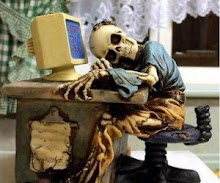
In my last post, Ms Refusenik comments:
"Is it just petty of me to want to design my green funeral as if I were coming to it? I mean I don't care if other people don't want want to sit through Neil Young's long and passionate "Will to Love." It was a theme song of mine for years."
She storms on with some great, high-energy stuff. I'm going to stay, in my prosaic way, with her opening question, and in that irritatingly liberal way, I'll start my answer with a question: "Who is my funeral for?" because to answer that question is to answer hers too, it seems to me. And there isn't one answer for all.
I guess in belief systems around the world, the answer used to be, and sometimes still is, "my funeral is for me." That's because death rites had to be performed right, or the soul would not get off on its journey, or would not have what it needed for that journey - be that an entire terracotta army, or just a few cooking pots, or pennies on the eyes to pay Charon, the boatman who rowed you over the River Styx to Hades. Less dramatically, they simply had to be performed right to fit the religion of the dead person, so Christians needed to be buried in a churchyard, and if (soldiers) they couldn't, then you sanctified the ground around them with a rudimentary cross, and the appropriate scriptural words.
But with all due respect to the mighty Neil Young, (or Mozart, or Miles, or The Clash, whoever you want ringing out over your shroud/coffin) I don't think not playing the right music will imperil anyone's soul-journey to the after-life. Though many who believe in an after-life would feel that the right prayers need to be said to help the soul depart.
Such considerations don't apply in my own case, because it seems highly unlikely to me that I've got a soul bound for another place, in any literal or real sense. That being the case, I shan't be looking on, or offended if the "right" things don't happen. My own feeling is that the funeral will not be for me. There will be no me. Some of the funeral may be about me as I was, but my funeral will be for those who were close to me.
It's so that an extraordinary psychic change can happen in those present - the pain of releasing a body into the ground or the fire allows the true meaning of a life to come through for those present, not necessarily on the spot, but certainly afterwards. Our lives are em-bodied. We have to free their meaning from the awful constrictions and claustrophobia of grief by saying farewell to that body - properly.
It hurts, whether you're listening to Neil Young or The Sex Pistols, it hurts no matter how much you celebrate the life that was lived. It hurts more if something awful has happened, if the person was young, etc. But even for an 87-year old who keels over quickly and doesn't suffer, if she mattered to you, you feel the sharpness of grief. Then you can take forward what the life means to you. Least, that how it seems to me.
If I had The Sex Pistols played at my funeral, just for the sake of a gesture, The Long-Suffering One would be upset. They aren't from the era of our youth, they have no resonance for us, they were culturally interesting maybe but neither of us listen to them with any pleasure. Or to choose something more likely, if I thought it would be amusing, and arranged for "Always Look On The Bright Side of Life" from "The Life of Brian," I don't think my family would be amused. Or comforted, or helped. Some might, not mine - even though I hugely enjoy the movie. (Of course it's not blasphemous, does anyone still think so?)
If Ms Refusenik has her Neil Young, what will it do for those there? Well, if it was a theme of hers for years, surely at least some of those attending would recognise that, smile, sob, mutter "that's so her, and at full volume too. Rock out, kid" or whatever. And seems to me it's the same with all elements of a funeral. Look for the resonance, the association, the words that enable the grief to flower and the funereal cramps eventually to subside.
It would be odd, at best, to have my funeral according to some plan of mine, that meant nothing to those who were there, even if it would have meant something to the me who isn't any more.
No, it's not petty to plan it as though you were there, Ms R. - maybe that will ensure it means something to those who will be there? And may it be a long, enlightened and happy time off.
Showing posts with label bodies. Show all posts
Showing posts with label bodies. Show all posts
Sunday, 9 January 2011


Friday, 11 June 2010
Bodies and funerals part 1
Part of the function of a funeral is to dispose of a body, and yet you don't need a funeral to do so. So: what is a body doing at a funeral? Not much, answered the wag, but what I mean is: why is it there, what should we do with it, how do celebrants and undertakers think it's best to help mourners with their feelings and attitudes towards a body? Can I answer all these questions once and for all? Well, erm, possibly not, since it's a huge question that opens out into psychology, philosophy, sociology, politics, theology and so on and on. But the debate we're engaged in via The Good Funeral Guide is so valuable to me that the least I can do is to try to blunder into a view or two for your disposal.
The GFG discussions have certainly developed my views on this. If you're interested, see "a body isn't a person and a coffin is just a box, but..." 29 January, on this blog.
Whatever else we are or are not: we are animals. We animate a body. The pulse of energy that is a life ( a tiny moment in the universe) leaves behind it the physical entity that generated and sustained that energy. All this is true whether you think there is a soul, a spirit or some other survivable essence. (As you may have gathered, I don't think that's at all likely, myself.)
In our world as it is, we can only find meaning by relating to animated bodies (and in different ways the rest of the physical universe, of course.) An animated body is a living person, but a dead body is not. It looks as though it should be, it sometimes looks as though it still could be. All this is a huge shock and a great mystery. A life has stopped. A life force has gone. What now?
We may or may not go and look at the body-that-was-a-person again after it becomes inanimate. We may or may not pay for some skilful people to do slightly odd things with the body so that it looks as though it is "only sleeping." Sooner or later we will put this thing which was a person who mattered to us, but isn't a person any longer, into a box and either burn it or put it into the ground.
We keep telling ourselves it's not a person any longer, but where is the person? asks the mourner. Gone. In the box? No. That's a body not a person. You're going to have let go of it. Jesus Christ, that hurts, that really hurts. You mean I have to let go of this - relic that was someone I loved? How can I do that? Why is she not here? Where is she? Help me, please, for God's sake help me.
Enter the funeral celebrant. Easy task, then. Wind her/him up with a bit of training so she can manage a crem, and off she goes. No worries, she has her professional distance.
Er, hang on, that's an ex-37-year old mother in her box and her three children are in the front row, tears streaming down their faces, alongside their heroic father, who is trembling with grey-faced tension.
How are you doing with the distance thing? Unless you are the stoic of stoics, or an unfeeling self-centred fool, possibly not so well.
They want you, celebrant, (that title seems a bit silly now, perhaps...) to help them part with all that's physically left of their mother, his wife. They need you to hold it together, they want something coherent; you can't feel as they do, you can't understand how they feel, there's no reason why you should, but I don't think they want too much professional distance. When they met you, they were looking for a sign that you understood just a little of what's happened to them, and shared just a little of their grief, enough to empathise, not enough to make your ego too prominent. You are not one of them, and yet in a particular sense, you are, for a few very important days. You need to enter their circle of grief as a guest, not stand outside it looking in. Then they can relate to you, and you can get from them what you need to make something of their half-hour in that shabby desolate dump of a crem you're all lumbered with.
Right. here you go then.
Friday, 29 January 2010
A body isn't a person and a coffin is just a box - but...
Sorry it's so long - it's a big subject.
An obvious enough point to open with: the attitude towards the coffin and the body inside it at a funeral is probably different for every single person at that funeral. This doesn't mean that we should not try to make intelligent cultural generalisations about attitudes towards the body at a funeral but I think that the job in hand is to find a workable relationship at a funeral ceremony between the audience and the coffin. I think this has to take priority over any personal views I may have about changing our attitudes towards bodies at funerals.
I have taken crematorium funerals at which the bereaved family has wanted to enter not behind but alongside the coffin, carrying it or at least with a hand on the coffin, if it is on a trolley. Sometimes families will ask for the curtain (or whatever the coffin disappearing mechanism might be) not to be drawn. In my view, this can make it harder for the bereaved to leave at the end of the ceremony because there has been less of a structured farewell. But against this, for such families, comes the need they have to go over to the coffin at the end of the ceremony, stand by it, put more flowers on it, rest a hand on it for a moment and so on.
I have also taken funerals at which the bereaved family want as little as possible to do with the coffin and they are clearly much relieved when the curtain is drawn. This is not necessarily an indication of the depth of their grief, of course.
I have taken many fewer burials than cremations, but I have not observed any substantial differences in the attitude of the bereaved to the coffin (allowing for obvious translations between a crematorium plinth and an open grave.)
As a celebrant, I feel I have to walk a fine line between offering advice on the way the funeral could go and making sure that the family get the ceremony they want; after all, it is their ceremony and not mine, and my job is to help them identify and then realise their preferences.
I used to feel that differing attitudes towards bodies were only the product of religious beliefs or their absence. So a full-blown atheist might be expected to regard the body as the relic life has left behind, to be disposed of appropriately via a suitable ceremony, the body as an object, having no special significance or resonance once life has left it.
Whereas, Christianity used to be a resurrective religion, in that there was a literal belief that the dead would rise again in their bodies from their graves (see the paintings of Stanley Spencer) and therefore had, presumably, a very different attitude towards the body at a funeral. It seems to me now that most Christians don't believe that and I must say I find that a bit of a relief because I never could resist seeing such an event as a sequence from a very tacky horror flick!
In fact I can see little difference, in theory, between atheists and religious people, because if religious people believe that a spirit or soul has left the body behind, then presumably it is no longer needed, just as an atheist would say that the life has ended and the body is simply what is left over. And yet - it doesn't seem like that in practice. It's tough parting with the body in the box at funerals. If anyone is going to get upset, it'll probably be at the committal.
So I was being a little naive, about what I expect from atheists and religious people. Somehow, people have to let a body go. It's very difficult to do, because the life of the person they knew was embodied - literally, in that body. The life and the body were the same thing. The body is now a different body, and the mourners have to move towards seeing it as different - something they must let go of. They have to leave with something non-physical, with an enhanced sense nof the meaning of the life that is ended. My job is to help them do that, in the way that best suits them.
In many ancient societies, bodies were buried with the accoutrements the person used in his/her lifes, in the belief that they would be useful in an afterlife. We have a sentimental relic of this in the way some people want their loved ones cremated or buried with an object or two that mattered to them when they were alive. I am not being judgemental or unkind when I call this sentimental; I mean it literally, it is a matter of sentiment and feeling, not of any actual belief that the items will get used again.
Let me try to some up some views:
1. The box is a nuisance, because it isn't the person. The meaning of that person's life is in the thoughts - in the hearts, if you prefer - of the mourners. The box upsets people, and stops them concentrating on the life they are there to celebrate. The body inside the box is finished with. Saying goodbye to it is not saying goodbye to the person. The best sort of an event might be a memorial ceremony without a coffin, so we can concentrate on the life, not the remains.
2. A funeral is a rite of passage; the box must be part of that rite, so that people feel they have said a farewell to the person, but it is appropriate to distance the box from the mourners because it is an item in a ceremony, not the person him/herself - it represents, or symbolises, the living person. A body is not a person. So it's appropriate to have the coffin at a distance most of the time.
3. It is the person we are saying goodbye to. The box should be at the centre of things, possibly even open so we can see the person. We can't say goodbye to the person without saying goodbye to the body - after all, they were the same thing, for all the years of a life.
Well, unless you make a real effort, you'll get something close to #2 at a standard UK crematorium or cemetery. I took a funeral that was held in a village hall, with the body in a wicker coffin up front. Family speakers went over and laid a hand on the coffin once or twice; speakers spoke directly to the coffin, addressing the body by name. We then progressed to a graveyard for a brief burial ceremony (in the pissing rain, as sadly so often seems to happen.) Those people didn't actually think there was a person in the box, but it helped them say goodbye. It was a #2-type ceremony, but nicely individualised and made more human in scale. One reason is because it wasn't in a crematorium. More on crems another time.
So with respect to the excellent Mr Long*, I can see a real point, for some people, in a funeral/memorial ceremony without a body, following on from a committal (or preceding it, as above) attended by a few people only.
But whatever my views about the body in the box, my function is to tune the ceremony to the family's views and attitudes. If we want a richer ceremony than the standard #2 usually is, I think that has to come about through thought, discussion, social change etc, I don't want to force the pace with the families I work with - though Mr Long has made me think that my funerals could be better ceremonies if they sometimes offered families a little more ritual about them, and that would require some creativity and some tact on my part, not to force the pace. But I'm quite cautious - one of the blokes at one of the crematoria said to me that he'd seen it all - pagan funerals with robes and candles and flowers everywhere, people standing on the chairs, people dancing at the front. Well, I've not been asked for that yet. Though I did have a rogue piper once - but that's another story...
* blog The Good Funeral Guide, 29 January 2010.
http://www.goodfuneralguide.co.uk/2010/01/thomas-g-long.html
Subscribe to:
Posts (Atom)