skip to main |
skip to sidebar
It seems to me that we are not single
entities, but pluralities, full of the voices and gestures of people we
have known, the places we have lived, and then some. We are unfolding
processes, and our present moment, our “now,” is arrived at from “them”
and “then” and “there.”
During meditation, it is possible, even for an inconsistent lightweight of a meditator like me, to let go of the trains of thought that usually occupy the mind, and be in the present moment; to drop concepts and judgements, and just be. It doesn't last long before the scripts start running again, and I need to bring the mind back again to the present - often to the breath.
This to and fro motion is, of course, what a meditation is, for most of us. The Balance is never static, as a tightrope walker might tell us.
For those moments of presentness, them then and there fall away. When I return to my plural self, it is with more calmness and a better balance. Perhaps for a while I am more fully a plurality, and happy with it; I am not struggling so much to sustain one single "I," worrying about claiming things for my ego. It's easier then to accept change, uncertainty, provisionality.
Meditation, like exercise, can be addictive!
Powerful myth-makers all three. I'll argue here that
"His Dark Materials" and "The Earthsea Quartet" are better for us than
Tolkien, and that it does actually matter, because it relates to how we
see evil and good in human behaviour.
Fine writers all three, Tolkien (above) in particular an
eminent scholar and prof. But in The Lord of the Rings, creatures tend
to be either good or evil, and the source of evil is ultimately
supernatural. I mean, what is the Dark Lord? Orcs, some humans
(Wormtongue) bad, skewer 'em. Hobbits good, most men good, elves good.
OK, there are exceptions - Boromir gives way to jealousy and greed for
power, and dies for it - but mostly, evil in the book comes from
without, not within, the major characters.
In Phillip Pullman's trilogy, evil is altogether more
complex. Bad things are done for what might be good reasons. It helps
that Will and Lyra are well-rooted in their own worlds. Individuals
behave both badly and well, and it doesn't take a Dark Lord to tempt
them. In fact, there is no external Dark Lord.
A
more profound thinker on the problem of evil, yet a creator of
unforgettable characters and events, as all three of these writers are.
Ursula LeGuin's Earthsea Quartet takes us back into the
land of wizards and dark forces, but it's not MiddleEarth, because her
wizard is much more complex than Gandalf; the harshness and cruelty of
his early life makes him a difficult person, and out of this comes, in
the first book, a dangerous and damaging act- he releases a supernatural
evil thingy into the world, and eventually he has to deal with it.
Less
well-known now than the other two, she is under-rated and comparatively
under-read. There is much of Earthsea in the Harry Potter stuff. (I'm
being polite...I seem to remember that Le Guin said yes, she was a bit
startled at first, but took it as a compliment and moved on. A lesser
soul might have reached for the lawyers. )
OK, so what?
If we simplify evil it is much easier to dismiss the
Other as "the bad guys." Nice and simple. A War on Terror, as The
Simpleton President put it. Islamist terrorists do dreadful things, but
there is no Dark Lord, there is no Mordor. The way to deal with evil is
surely not to simplify it.
There is hatred, cruelty, fear, greed within
each of us, to differing degrees and we come to terms with it, control it, or fail to do so. A War on Evil would be a war on ourselves, each of us. Oversimplifying evil is a dangerous temptation.
In this song, the character feels lost and confused in a world full of grey.
That's right Oscar - it's hard dealing with the complexities of life, it takes a lot of emotional and intellectual maturity. We surely deal with terrorism by combating terrorist plots and actions, and addressing the causes of their rage, intolerance and hatred, not by oversimplifying them as "the bad guys," servants of Mordor.
The moral world of the Lord of the Rings, much as I love it, is infantile, compared with that of Pullman and Le Guin, and it seems to me that powerful cultural artefacts do influence at some level how we see the world. In "Despatches," Michael Herr describes young marines in Vietnam behaving like the John Wayne characters they had seen in movies....
If we are lucky enough not to live in dreadful poverty and danger, if the circumstances of our lives don't drive us to bitterness desperation, we should at least stand a chance of finding the Balance within us that stops us running for easy answers that are no answers. Even North Korea isn't Mordor (though I confess it's not my ideal holiday destination.)
Interesting comments on the death of Margaret Thatcher. Some commentators thinking through what UK would be like if she'd never been prime minister; others pointing out the paradoxes in her premiership (e.g. she hated feminism but did so much for female role-modelling; she espoused Victorian values such as thrift and passed the legislation that began the whole "casino banking" era, bringing huge wealth into London and...well, you know where we are now!)
Naturally ex-miners and union leaders have little good to say, although some of her opponents seem now to be admitting that the power of trade unions did need to be contained and controlled. And I'd actually forgotten that Arthur Scargill brought the NUM out on strike without balloting them first.
And then there are the absolutists, the de-humanisers. George Galloway MP apparently says he hopes she burns in hell. An Irish cricketer says he hoped her final illness was long and painful; he has since "apologised." Don't use Twitter unthinkingly, it's PUBLIC, remember, idiot? Did you even think for half a second of her family?
There is the taboo on not speaking ill - well, not too ill - of the dead. A woman said to me that she wanted this line in her husband's funeral: "He was a grumpy old bugger, but he was my grumpy old bugger!" That's usually about as far as it gets, in private life.
So if someone had succeeded in blowing Hitler up in 1944, should people not have celebrated? H'mm. Obviously, there are limits to the taboo.
But Thatcher wasn't Hitler. The absolutists, the bitter Thatcher-haters, should remember that for better or for worse, she was elected three times to the post of prime minister.
Which brings me to the Sex Pistols: "God Save the Queen, the fascist regime..."
Each generation gets its turn to be nostalgic, and there's a lot of it around these days about punk. Well, I had my turn ref the 60s I guess, though my memory isn't so shot that I can't distinguish between nostalgia and reality. Drugs? I was told by an "insider" that by the time Hendrix died, he was dropping LSD, literally, into his eyes with an old-fashioned eye dropper.
Hurrumph. Here goes:
The Sex Pistols? Only a talentless adolescent with limited experience of life could possibly think that the UK was run by a fascist regime. If it had been, the first thing that would have happened when the authorities heard that song is that the band would have been squashed - an irony that was pointed out at the time. Presumably whoever "wrote" the song was a political infant as well as a generator of horrible noises (OK sorry that's just my prejudices!)
Later in the song he says the Queen isn't a human being. There we are - dehumanise. Polarise. I wonder if the Sex Pistols ever stood at the gates of Auschwitz and thought about how we need to dehumanise humans if we are going to destroy them?
Look for The Balance. Find a civilised way to criticise, to lament Mrs Thatcher's effect on the country, to express your dislike of everything she stood for. All you do if you hurl malevolence at her at present is display your own limited sense of humanity. Ironically, since she is so often blamed for the breakdown of consensual politics, you are prolonging that lack of consensus, feeding that divisiveness. You also prolong her influence over you.
The need for us to acknowledge that every human being is a human being is perhaps the only absolute value worth holding to. If we don't, we can never understand why people do as they do. If we don't, we make ourselves a little less human.
Next post will relate to this via Viktor Frankl and the camps he survived.
I think what I was trying to get at the other day is that people seem to need a way of feeling in balance; at home, in a profound sense. They want to feel linked to the rest of the world about them, and not just to human society; they want to feel a sense of unity with The Way Things Are.
Aspects of physical and biological science can help us do that via reason. For example, the characteristics we share with other living creatures, the way the seasons work on us, or the wonders and mysteries revealed by astronomy. Such insights can lead to a fuller identification with the rest of the universe - e.g. some of the things Einstein wrote in later life. Sometimes such insights are labelled "spiritual," a complex and conflicted term these days perhaps.
Before scientific methodology and rational analysis, people found this harmony in ways that might not stack up rationally, but I think they can still have a symbolic beauty for us, and even, for some of us, a functional utility.
Astrology is, I think, not rationally supportable (which is a polite way of saying that at the literal level, I don't believe a word of it!) However, sensible, bright people follow it, including a lovely colleague of mine. It's unwise to think that people who believe irrational things are foolish; patently not so.
We should look at the purpose, function and symbolic eloquence of such systems as astrology, even if we don't accept them ourselves. I believe they help some people who are looking for a sense of balance and belonging, unity with the universe. Edmund, the wicked bastard in "King Lear," says in effect "It's nonsense. I'd be lecherous and uncouth whatever stars reigned over my conception and nativity." He was a modern man in his day.
I don't know enough about other cultures to generalise, but there is one well-known symbol of balance, the ancient Chinese Yin-Yang. Like many profound things, it is beautifully simple.
Thus saieth Wikipedia, helpfully I think:
In Chinese philosophy, the concept of Yin-Yang, which is often referred to in the West as "yin and yang," literally meaning "shadow and light," is used to describe how polar opposites or seemingly contrary forces are interconnected and interdependent in the natural world, and how they give rise to each other in turn in relation to each other.
Everything has yin and yang aspects, opposite dualities that are ultimately interdependent, different ways of seeing and understanding an inexpressible unity. The symbol may have become a cliché, but the mode of thought is fascinating, and I think productive. To risk stating the bleedin' obvious, you can't have light without dark, music without silence - life without death. These dualities are not opposed, they make up the one, even if we see first yin and then yang.
The Balance. Ever changing within us and without us. If you veer away from death, deny it in your life, you drain your life of meaning and intensity. If you are incapacitated by your (natural) fear of death, you darken your life.
The Balance is there all the time, you can't will it within yourself. You can't say "I will be mindful today," or "I will stop worrying about the end of my life."
Meditation is one way to let The Balance emerge. But enough from me, on the way. You know what's coming next:
"The Way that can be named is not the perfect Way."
We depend on internal balances in our bodies to keep us alive, and some or many illnesses come from that balance slipping. What about balance in the universe around us?
The wider universe, astronomers physicists etc tell us, is a place of unimaginable power, randomness and (according to Hubble) beauty. Exploding supernovae, colliding planetary bodies and collapsing neutron stars, let alone black holes, are not places of balance - though just maybe there is a larger, all-encompassing balance in it all, I don't know enough physics to take that further; some would call such a balance God.
In our own planet, balance sustains us here too. Air pressures, water temperatures, ocean currents all move together, and when they are out of the usual balances, you get - hurricane Sandy etc. When the tectonic plates are not evenly balanced, you get movements to put them back in balance and - people suffer earthquakes.
A holistic view of medicine is almost a commonplace now - looking at the whole person to see where in her systems something is out of balance, rather than finding a magic bullet drug to deal with the symptoms of one problem. (Mind you, magic bullets are very useful sometimes!) The quest is to get the person back in balance, as far as possible.
In medieval and Renaissance times, it was taken as a commonplace that we are composed of four humours (black bile, yellow bile, phlegm, and blood.) OK, it's quaint - remember, they hadn't yet found out that blood circulates round the body, and they had little idea of what the brain did. They believed that if the four humours weren't in balance, you fell ill, or at best behaved oddly. Too much blood made you choleric, i.e. bad tempered. Too much black bile made you depressed. The work of Shakespeare and his pals is full of it - one of Ben Jonson's plays is called "Every Man Out Of His Humour." These people were not stupid primitives. They simply made wonderful work out of prevailing beliefs, which is all you can ask of any artist at any time, surely.
The four humours corresponded to the four elements of earth, air, fire and water, and again, these elements were made to stand in for personality types, or even types of creature: Ariel, in "The Tempest," is all air. Caliban is all earth.
Furthermore (hang in there please, there is a point to all this) the elements and the humours were influenced by the motion of the stars and planets. Human affairs were thus affected by heavenly bodies. "When beggars die, there are no comets seen. The heavens themselves blaze forth the death of princes." (Cue convenient comet...) And vice versa.
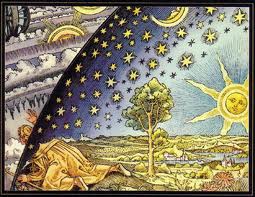
Before the great 17th and 17th century astronomers - Coppernickers, Galileo, Kepler and all - everyone thought the sun and the planets and the stars revolved around the earth. They were fixed on crystal spheres, which made impossibly beautiful music, if you were spiritually advanced i.e. holy enough to hear it - the music of the spheres. Outside the stars and planets was - God in heaven. The stars etc, and of course heaven, are unchangeable. Below the moon (i.e. on earth) all is change, all is mortal. On earth was mankind, higher than the animals but "a little lower than the angels." At the centre of the earth was hell, and at the centre of hell was - Satan himself. God-angels-mankind-animals-devils-Satan.
(This is all too neat, there were lots of variations...but for now...)
So what is sometimes called the Great Chain of Being linked God in heaven through the stars and down to mankind on earth, trying to be good so as to ascend to heaven. Stars etc affect our moods, our health, the events in our lives. It's all linked. The virtuous, healthy person keeps it all in balance; the sinful or just plain ill person has lost their balance. Huge injustices on earth will be mirrored in the skies, as happens when Julius Caesar is murdered, Macbeth kills Duncan.
OK, the universe, we learn from science, isn't like that. (Put God where you like, He's not the issue here.) Our bodies don't work like that. When awful things happen on earth, the stars couldn't give a damn - they are too busy being convulsed in beautiful and terrifyingly vast explosions.
But hang on - out of all this, lets pull The Balance. Because we are not just machines to be oiled by medicines. Emotions affect physical well-being affects emotions. The passage of the seasons affects us, via amounts of sunlight falling on us. Our brains are continually modified by how we use them, i.e. by the impact of The World on them - printed book, or X-Box? Both will influence the structural working of your brain. The world moves through us as we move through the world.
The beautiful intimacy of the old Chain of Being myths no longer convince.
But we generate and expend energy every day seeking The Balance, at which we will function best - healthiest, happiest. Millions of people go walking, listen to music, meditate, in order to feel balanced. When we run out of energy, our bodies give way, and we die. We have had to give up the balance through which we live.
The pre-Copernican universe, the view of our bodily workings pre-modern medical science, these myths were just rather lovely ways of trying to comprehend order and balance in the universe. We know enough now to maintain essential balances, which is just as well, because order and balance isn't inherent in the workings of the universe, in any physical sense. We know enough to hold the balance, but all too often we don't seem to be able to bring the knowledge to bear.
This isn't my clearest ever post, but there is something here I don't want to lose sight of.