skip to main |
skip to sidebar
Almost always, we celebrants/ministers are asked, or expected, to give an account of someone's life. One of the privileges of this work is that we learn about so many lives. Every life is a story to be told, of course, and each of them is unique. But we have to be careful. On their own, the facts of a life may do little to bring significance to a funeral.
I well understand the paradoxical value to bereaved people of being told something many of them probably know already. The real task seems to me to be using biographical detail to illuminate the sort of person s/he was, and looking for that smile or nod of recognition. That's surely what illuminates the meaning of a life for the people who badly need to take something away from a dreary old crem.
For me, writing the script for a ceremony, it's always an imagined life. I like the challenge of using what I've been told and adding some imaginative resonance. "The vehicle weighted over a ton and a half, and when I tell you that he had to shove it back into the garage, on his own, we can understand just how strong and determined he was."
Sometimes, I feel a life fact can stand on its own: "...and he fought his way from D-Day plus 2, to the banks of the Rhine," but nevertheless, an appeal to the congregation's imagination might help: "... and all that time, Emily didn't know where - or how - he was."
Doesn't have to be dramatic or spectacular: "..and he loved gardening. Many of us do, but how about this for dedication: Jill looked out of the bedroom window one night at two in the morning and saw a torch moving around the garden. She went to wake Bill, then realised it was him in the garden. Slug hunting. At two in the morning. In the rain..."
I've found it salutary to recognise, after hearing so many facts about so many lives, that an imagined life is more than the facts; yet at the same time, to accept that it is all too easy to over-extend the imaginative work and add something that won't ring true.
Well, there's no formula for these things. In we go to listen to a family, receptors tuned, looking to get it right every time. But getting it right is relative. Success is always limited; significant failure cannot be contemplated.
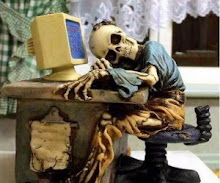
I sometimes feel a bit like the little chap in the picture, making something (a ceremony) in which my role looks simple in plan, but turns out to be full of paradox, ultimately impossible.
Any celebrants out there dis/agree with any of this? Do chip in:
1. I didn't know the person who's died, but I have (usually) to present a picture of her - life story plus essential characteristics, looking for the spark of recognition in the upturned faces. If I overdo it, people will feel I am being presumptuous. If I undercook it, the congregation will find it harder to feel the connection. A catalogue of jobs, hobbies and retirement activities, and health problems doesn't do. We need to feel the uniqueness of the person, but the only possible view, for me to use, is the one from one or two people in the family. It's my empathy, imagination, background knowledge I shall have to draw on. Mustn't over do it....
2. I want to give the event some ritualistic power, some ceremonial effect, but the common threads for assembling such a thing are few and faded. Ritual and ceremony evolve over time, but we're trying to invent them. It kind of works, sometimes.
3. I need to stay in control of the ceremony, however distressing the circumstances. But celebrants who can't bring love and compassion to the people they are working for should perhaps be doing something else. Those qualities cannot be faked as part of a professional performance, but my part of the proceedings needs to be calm and ordered. I need to be moved, I won't help anyone if I lose it.
4. I draw on my own emotions, my own thoughts about mortality and loss, but if I draw too deeply I run the risk of exhausting and depressing myself. If I don't draw upon anything of mine, the ceremony may lack my own personal commitment, therefore it will lack authenticity. If I drain myself over a few weeks, I'll be less able to energise the next funeral.
5. I don't want to take on too many funerals (see above) but if I turn down a request, I worry that a suitable alternative may not be available. (That's not, I hope, vanity, merely availability of celebrants who are at least as good (or bad) as me.)
6. I'm not in it for the money, but I find it difficult sometimes not to feel cross about the attitudes towards celebrancy fees from the rest of the funeral so-called profession.
7. Who am I to talk about the meaning of a life I never knew, and draw from it something for the people to carry away with them? Yet I know how hard it is for family members to make that sort of synthesis - much as I want to see them do as much of the funeral for themselves as they can. It's probably only people with considerable cultural resources, time, maybe money, who can do that for those close to them.
8. Celebrants often feel they need to present an honest picture of the person, but they don't want to hurt feelings, they want to help people along with their grieving. It's not a forensic activity; yet no-one respects a whitewash.
9. Celebrants often want to transform the way our culture "does" end-of-life matters in general and funerals in particular. But here and now, most people want something fairly or very conventional.
10. There is no such thing as a secular funeral that is ideally suited to purpose, occasion and dead person. It's an impossible job.
It's the best job I've ever had.